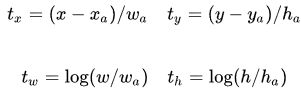
在这篇文章中,我们将使用 Tensorflow2.0 实现 Faster-RCNN。对 Faster-RCNN 的原理感兴趣的小伙伴可以参考一文读懂Faster RCNN。 在这里我们主要对相关代码进行解释说明。我们将使用5个文件来实现 Faster-RCNN: wandhG 中包含着 9 个预测框的宽度和长度(这是经过 kmeans 算法计算过的结果)。 load_gt_boxes() 函数返回一个 (-1, 4) 的数组,代表着多个检测物体的 ground truth boxes (即真实检测框)的左上角坐标和右下角坐标。 其中,我们需要输入一个路径,此路径下的 .txt 文件中包含着真实框的 (x, y, w, h),x 表示真实框左上角的横坐标;y 表示真实框左上角的纵坐标;w 表示真实框的宽度;h 表示真实框的高度。 plot_boxes_on_image() 函数的输入有两个,分别是:需要被画上检测框的原始图片以及检测框的左上角和右下角的坐标。其输出为被画上检测框的图片。 compute_iou() 函数用来计算 IOU 值,即真实检测框与预测检测框(当然也可以是任意两个检测框)的交集面积比上它们的并集面积,这个值越大,代表这个预测框与真实框的位置越接近。用下面这个图片表示: 因为所有预测框的中心点位置(即特征图的每个块中心)以及尺寸(9个标准尺寸)都是固定的,那么这一定会导致获得的检测框很不准确。因此,我们希望创造一个映射,可以通过输入正预测框经过映射得到一个跟真实框更接近的回归框。 假设正预测框的坐标为 那么,如何让正预测框变成回归框呢? 这里的 正预测框与真实框之间的平移量 decode_output 函数的作用是,将一张图片上的 45*60*9 个预测框的平移量与尺度因子以及每个框的得分输入,得到每个正预测框对应的回归框(其实所有表示同一个检测目标的回归框都是近似重合的)。 对于输入: 其中,经过 meshgrid() 函数后,grid_x 的形状为 (45, 60),grid_y 的性状也是 (45, 60),它们的不同是:grid_x 由 45 行 range(60) 组成;grid_y 由 60 列 range(45) 组成。 经过 stack() 函数后,grid_xy 包含着所有特征图中小块的左上角的坐标,如 (0, 0),(1, 0),……,(59, 0),(0, 1),……,(59, 44)。 因为特征图中一个小块能表示原始图像中一块 16*16 的区域(也就是说,特征图中一个 1*1 的小块对应着原始图像上一个 16*16 的小块),所以计算原始图像上每个小块的中心 center_xy 时,只需要用 grid_xy 乘 16 加 8 即可。 计算预测框的左上角坐标时,只需要用 center_xy 减去提前规定的预测框的宽度和长度(wandhG)的一半即可。 xy_min 和 xy_max 是回归框的左上角坐标和右下角坐标,它们的计算过程在 compute_regression() 函数那里已经讲过了,此处的 pred_bboxes 输入就是 compute_regression() 函数的输出,其中包含着每个框的平移量和尺度因子。然后将xy_min 和 xy_max 合并,得到新的 pred_bboxes,其中包含着回归框左上角坐标和右下角坐标。 pred_scores[…, 1] 指的是每个框中含有检测目标的概率(称为得分),如果得分大于阈值,我们就认为这个框中检测到了目标,然后我们把这个框的坐标和得分提取出来,组成新的 pred_bboxes 和 pred_scores。 经过 decode_output 函数的输出为: 非极大值抑制(Non-Maximum Suppression,NMS),顾名思义就是抑制不是极大值的元素,说白了就是去除掉那些重叠率较高但得分较低的预测框。 nms() 函数的作用是从选出的正预测框中进一步选出最好的 n 个预测框,其中,n 指图片中检测物的个数。其流程为: 其实,到这儿,我们可以先用提供的人工标注的真实框坐标(左上角的坐标+宽+高)给图片中的检测目标画框来检验一下 utils.py 中的函数: 我们可以尝试将真实框画在图片上: 得到: 在这里,我们只考虑部分位置符合条件的预测框,如果这个预测框和某一个真实框(一张图片中可以有多个真实框,这取决于图片中检测目标的个数)的 IOU 值大于给定的正阈值,我们就称这个预测框为这个真实框的正预测框;如果这个预测框和某一个真实框的 IOU 值小于给定的负阈值,我们就称这个预测框为这个真实框的负预测框。 如果一个预测框为某真实框的正预测框,我们就将它的检测目标得分赋1,将其标记为正样本,并计算这个正预测框和它所对应的真实框之间的回归变量;如果一个预测框对所有真实框来说都是负预测框,我们就将它的背景得分赋-1,并将其标记为负样本。 最终得到: 得到: rpn.py 文件是用来建立 RPN 网络的,在这里,我们对原始的 RPN 网络进行了一些改进,其代码如下: 最后的输出有两个: 类似于 demo.py 中的操作: 我们只考虑部分位置符合条件的预测框,如果这个预测框和某一个真实框(一张图片中可以有多个真实框,这取决于图片中检测目标的个数)的 IOU 值大于给定的正阈值,我们就称这个预测框为这个真实框的正预测框;如果这个预测框和某一个真实框的 IOU 值小于给定的负阈值,我们就称这个预测框为这个真实框的负预测框。 如果一个预测框为某真实框的正预测框,我们就将它的检测目标得分赋1,将其标记为正样本,并计算这个正预测框和它所对应的真实框之间的回归变量;如果一个预测框对所有真实框来说都是负预测框,我们就将它的背景得分赋-1,并将其标记为负样本。 这里我们取8000张图片进行训练。 这里输出的 target 其实包括三个方面: 在这里,损失被分为两部分:分类损失和回归损失。 分类损失: 回归损失 最后我们将得到的 RPN 网络的权值保存下载,供测试集加载使用。 在测试文件中,我们选取200张图片作为测试集。测试一张图片的流程为:
文章目录
项目介绍
utils.py 中的函数说明
1、wandhG
import cv2 import numpy as np import tensorflow as tf wandhG = np.array([[ 74., 149.], [ 34., 149.], [ 86., 74.], [109., 132.], [172., 183.], [103., 229.], [149., 91.], [ 51., 132.], [ 57., 200.]], dtype=np.float32) 2、load_gt_boxes
def load_gt_boxes(path): bbs = open(path).readlines()[1:] roi = np.zeros([len(bbs), 4]) for iter_, bb in zip(range(len(bbs)), bbs): bb = bb.replace('n', '').split(' ') bbtype = bb[0] bba = np.array([float(bb[i]) for i in range(1, 5)]) ignore = int(bb[10]) ignore = ignore or (bbtype != 'person') ignore = ignore or (bba[3] < 40) bba[2] += bba[0] bba[3] += bba[1] roi[iter_, :4] = bba return roi 3、plot_boxes_on_image
def plot_boxes_on_image(show_image_with_boxes, boxes, color=[0, 0, 255], thickness=2): for box in boxes: cv2.rectangle(show_image_with_boxes, pt1=(int(box[0]), int(box[1])), pt2=(int(box[2]), int(box[3])), color=color, thickness=thickness) show_image_with_boxes = cv2.cvtColor(show_image_with_boxes, cv2.COLOR_BGR2RGB) return show_image_with_boxes 4、compute_iou
def compute_iou(boxes1, boxes2): left_up = np.maximum(boxes1[..., :2], boxes2[..., :2], ) right_down = np.minimum(boxes1[..., 2:], boxes2[..., 2:]) inter_wh = np.maximum(right_down - left_up, 0.0) # 交集的宽和长 inter_area = inter_wh[..., 0] * inter_wh[..., 1] # 交集的面积 boxes1_area = (boxes1[..., 2] - boxes1[..., 0]) * (boxes1[..., 3] - boxes1[..., 1]) # anchor 的面积 boxes2_area = (boxes2[..., 2] - boxes2[..., 0]) * (boxes2[..., 3] - boxes2[..., 1]) # ground truth boxes 的面积 union_area = boxes1_area + boxes2_area - inter_area # 并集的面积 ious = inter_area / union_area return ious
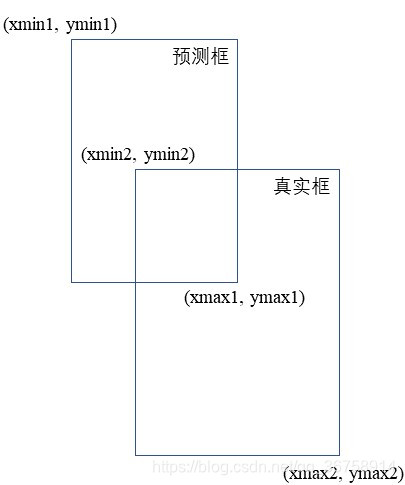
那么,left_up=[xmin2, ymin2];right_down=[xmax1, ymax1]。之后求出来这两个框的交集面积和并集面积,进而得到这两个框的 IOU 值。如果说得到的 IOU 值大于设置的正阈值,那么我们称这个预测框为正预测框(positive anchor),其中包含着检测目标;如果说得到的 IOU 值小于于设置的负阈值,那么我们称这个预测框为负预测框(negative anchor),其中包含着背景。5、compute_regression
,即正预测框左上角坐标为
,宽度为
,高度为
;真实框的坐标为
;回归框的坐标为
。
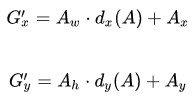
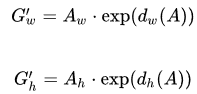
,
,
和
是我们需要学习的变换,称为回归变量。
与尺度因子
如下:
def compute_regression(box1, box2): target_reg = np.zeros(shape=[4,]) w1 = box1[2] - box1[0] h1 = box1[3] - box1[1] w2 = box2[2] - box2[0] h2 = box2[3] - box2[1] target_reg[0] = (box1[0] - box2[0]) / w2 target_reg[1] = (box1[1] - box2[1]) / h2 target_reg[2] = np.log(w1 / w2) target_reg[3] = np.log(h1 / h2) return target_reg 6、decode_output
def decode_output(pred_bboxes, pred_scores, score_thresh=0.5): grid_x, grid_y = tf.range(60, dtype=tf.int32), tf.range(45, dtype=tf.int32) grid_x, grid_y = tf.meshgrid(grid_x, grid_y) grid_x, grid_y = tf.expand_dims(grid_x, -1), tf.expand_dims(grid_y, -1) grid_xy = tf.stack([grid_x, grid_y], axis=-1) center_xy = grid_xy * 16 + 8 center_xy = tf.cast(center_xy, tf.float32) anchor_xymin = center_xy - 0.5 * wandhG xy_min = pred_bboxes[..., 0:2] * wandhG[:, 0:2] + anchor_xymin xy_max = tf.exp(pred_bboxes[..., 2:4]) * wandhG[:, 0:2] + xy_min pred_bboxes = tf.concat([xy_min, xy_max], axis=-1) pred_scores = pred_scores[..., 1] score_mask = pred_scores > score_thresh pred_bboxes = tf.reshape(pred_bboxes[score_mask], shape=[-1,4]).numpy() pred_scores = tf.reshape(pred_scores[score_mask], shape=[-1,]).numpy() return pred_scores, pred_bboxes
7、nms
def nms(pred_boxes, pred_score, iou_thresh): """ pred_boxes shape: [-1, 4] pred_score shape: [-1,] """ selected_boxes = [] while len(pred_boxes) > 0: max_idx = np.argmax(pred_score) selected_box = pred_boxes[max_idx] selected_boxes.append(selected_box) pred_boxes = np.concatenate([pred_boxes[:max_idx], pred_boxes[max_idx+1:]]) pred_score = np.concatenate([pred_score[:max_idx], pred_score[max_idx+1:]]) ious = compute_iou(selected_box, pred_boxes) iou_mask = ious <= 0.1 pred_boxes = pred_boxes[iou_mask] pred_score = pred_score[iou_mask] selected_boxes = np.array(selected_boxes) return selected_boxes demo.py
1、将 utils.py 中的函数导入
import cv2 import numpy as np import tensorflow as tf from PIL import Image from utils import compute_iou, plot_boxes_on_image, wandhG, load_gt_boxes, compute_regression, decode_output 2、设置阈值与相关参数
pos_thresh = 0.5 neg_thresh = 0.1 iou_thresh = 0.5 grid_width = 16 # 网格的长宽都是16,因为从原始图片到 feature map 经历了16倍的缩放 grid_height = 16 image_height = 720 image_width = 960 3、读取图片与真实框坐标
image_path = "./synthetic_dataset/synthetic_dataset/image/2.jpg" label_path = "./synthetic_dataset/synthetic_dataset/imageAno/2.txt" gt_boxes = load_gt_boxes(label_path) # 把 ground truth boxes 的坐标读取出来 raw_image = cv2.imread(image_path) # 将图片读取出来 (高,宽,通道数) image_with_gt_boxes = np.copy(raw_image) # 复制原始图片 plot_boxes_on_image(image_with_gt_boxes, gt_boxes) # 将 ground truth boxes 画在图片上 Image.fromarray(image_with_gt_boxes).show() # 展示画了 ground truth boxes 的图片

然后,我们需要再此复制原始图片用来求解每个预测框的得分和回归变量(平移量与尺度因子)。4、每个预测框的得分和训练变量
## 因为得到的 feature map 的长宽都是原始图片的 1/16,所以这里 45=720/16,60=960/16。 target_scores = np.zeros(shape=[45, 60, 9, 2]) # 0: background, 1: foreground, , target_bboxes = np.zeros(shape=[45, 60, 9, 4]) # t_x, t_y, t_w, t_h target_masks = np.zeros(shape=[45, 60, 9]) # negative_samples: -1, positive_samples: 1 ################################### ENCODE INPUT ################################# ## 将 feature map 分成 45*60 个小块 for i in range(45): for j in range(60): for k in range(9): center_x = j * grid_width + grid_width * 0.5 # 计算此小块的中心点横坐标 center_y = i * grid_height + grid_height * 0.5 # 计算此小块的中心点纵坐标 xmin = center_x - wandhG[k][0] * 0.5 # wandhG 是预测框的宽度和长度,xmin 是预测框在图上的左上角的横坐标 ymin = center_y - wandhG[k][1] * 0.5 # ymin 是预测框在图上的左上角的纵坐标 xmax = center_x + wandhG[k][0] * 0.5 # xmax 是预测框在图上的右下角的纵坐标 ymax = center_y + wandhG[k][1] * 0.5 # ymax 是预测框在图上的右下角的纵坐标 # ignore cross-boundary anchors if (xmin > -5) & (ymin > -5) & (xmax < (image_width+5)) & (ymax < (image_height+5)): anchor_boxes = np.array([xmin, ymin, xmax, ymax]) anchor_boxes = np.expand_dims(anchor_boxes, axis=0) # compute iou between this anchor and all ground-truth boxes in image. ious = compute_iou(anchor_boxes, gt_boxes) positive_masks = ious > pos_thresh negative_masks = ious < neg_thresh if np.any(positive_masks): plot_boxes_on_image(encoded_image, anchor_boxes, thickness=1) print("=> Encoding positive sample: %d, %d, %d" %(i, j, k)) cv2.circle(encoded_image, center=(int(0.5*(xmin+xmax)), int(0.5*(ymin+ymax))), radius=1, color=[255,0,0], thickness=4) # 正预测框的中心点用红圆表示 target_scores[i, j, k, 1] = 1. # 表示检测到物体 target_masks[i, j, k] = 1 # labeled as a positive sample # find out which ground-truth box matches this anchor max_iou_idx = np.argmax(ious) selected_gt_boxes = gt_boxes[max_iou_idx] target_bboxes[i, j, k] = compute_regression(selected_gt_boxes, anchor_boxes[0]) if np.all(negative_masks): target_scores[i, j, k, 0] = 1. # 表示是背景 target_masks[i, j, k] = -1 # labeled as a negative sample cv2.circle(encoded_image, center=(int(0.5*(xmin+xmax)), int(0.5*(ymin+ymax))), radius=1, color=[0,0,0], thickness=4) # 负预测框的中心点用黑圆表示 Image.fromarray(encoded_image).show()
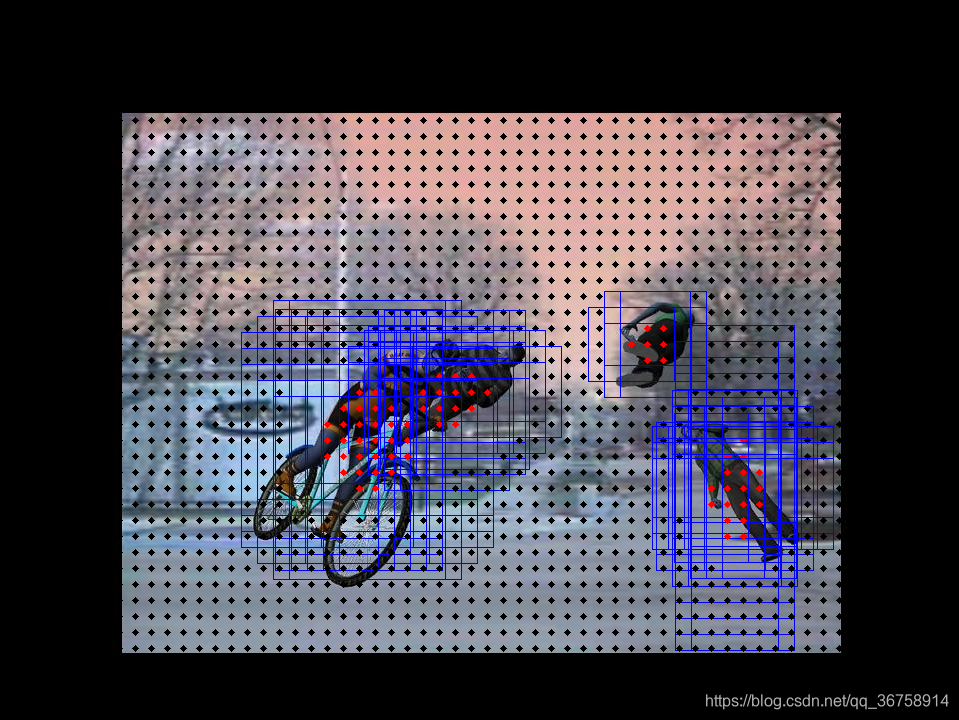
5、根据每个预测框的得分和训练变量得到回归框
############################## FASTER DECODE OUTPUT ############################### faster_decode_image = np.copy(raw_image) pred_bboxes = np.expand_dims(target_bboxes, 0).astype(np.float32) pred_scores = np.expand_dims(target_scores, 0).astype(np.float32) pred_scores, pred_bboxes = decode_output(pred_bboxes, pred_scores) plot_boxes_on_image(faster_decode_image, pred_bboxes, color=[255, 0, 0]) # red boundig box Image.fromarray(np.uint8(faster_decode_image)).show()
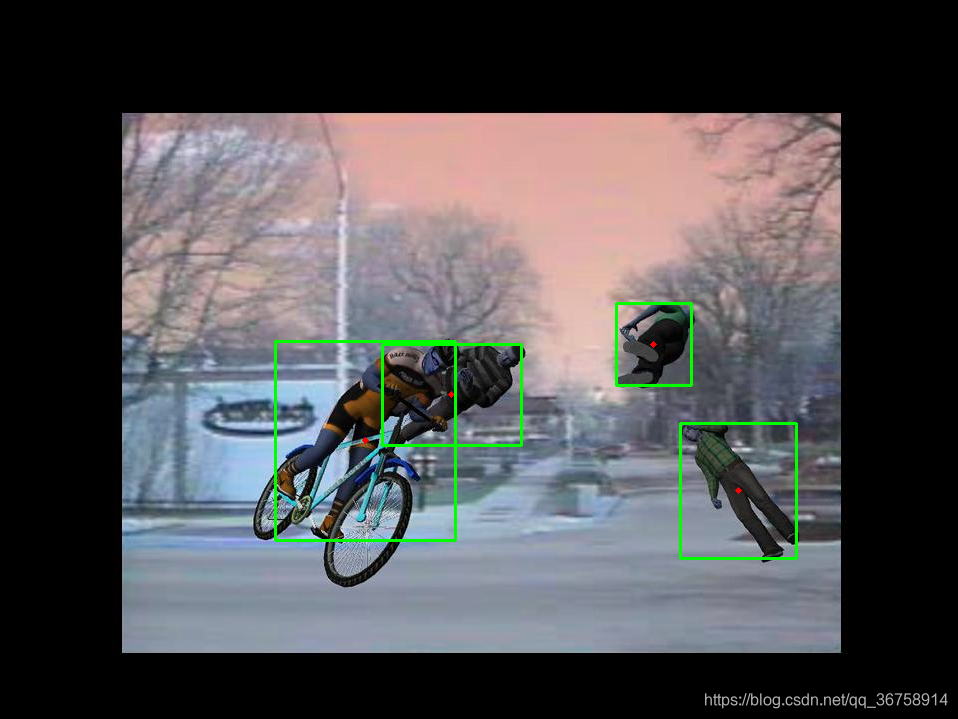
可见,回归框和真实框的位置差不多。rpn.py
import tensorflow as tf class RPNplus(tf.keras.Model): # VGG_MEAN = [103.939, 116.779, 123.68] def __init__(self): super(RPNplus, self).__init__() # conv1 self.conv1_1 = tf.keras.layers.Conv2D(64, 3, activation='relu', padding='same') self.conv1_2 = tf.keras.layers.Conv2D(64, 3, activation='relu', padding='same') self.pool1 = tf.keras.layers.MaxPooling2D(2, strides=2, padding='same') # conv2 self.conv2_1 = tf.keras.layers.Conv2D(128, 3, activation='relu', padding='same') self.conv2_2 = tf.keras.layers.Conv2D(128, 3, activation='relu', padding='same') self.pool2 = tf.keras.layers.MaxPooling2D(2, strides=2, padding='same') # conv3 self.conv3_1 = tf.keras.layers.Conv2D(256, 3, activation='relu', padding='same') self.conv3_2 = tf.keras.layers.Conv2D(256, 3, activation='relu', padding='same') self.conv3_3 = tf.keras.layers.Conv2D(256, 3, activation='relu', padding='same') self.pool3 = tf.keras.layers.MaxPooling2D(2, strides=2, padding='same') # conv4 self.conv4_1 = tf.keras.layers.Conv2D(512, 3, activation='relu', padding='same') self.conv4_2 = tf.keras.layers.Conv2D(512, 3, activation='relu', padding='same') self.conv4_3 = tf.keras.layers.Conv2D(512, 3, activation='relu', padding='same') self.pool4 = tf.keras.layers.MaxPooling2D(2, strides=2, padding='same') # conv5 self.conv5_1 = tf.keras.layers.Conv2D(512, 3, activation='relu', padding='same') self.conv5_2 = tf.keras.layers.Conv2D(512, 3, activation='relu', padding='same') self.conv5_3 = tf.keras.layers.Conv2D(512, 3, activation='relu', padding='same') self.pool5 = tf.keras.layers.MaxPooling2D(2, strides=2, padding='same') ## region_proposal_conv self.region_proposal_conv1 = tf.keras.layers.Conv2D(256, kernel_size=[5,2], activation=tf.nn.relu, padding='same', use_bias=False) self.region_proposal_conv2 = tf.keras.layers.Conv2D(512, kernel_size=[5,2], activation=tf.nn.relu, padding='same', use_bias=False) self.region_proposal_conv3 = tf.keras.layers.Conv2D(512, kernel_size=[5,2], activation=tf.nn.relu, padding='same', use_bias=False) ## Bounding Boxes Regression layer self.bboxes_conv = tf.keras.layers.Conv2D(36, kernel_size=[1,1], padding='same', use_bias=False) ## Output Scores layer self.scores_conv = tf.keras.layers.Conv2D(18, kernel_size=[1,1], padding='same', use_bias=False) def call(self, x, training=False): h = self.conv1_1(x) h = self.conv1_2(h) h = self.pool1(h) h = self.conv2_1(h) h = self.conv2_2(h) h = self.pool2(h) h = self.conv3_1(h) h = self.conv3_2(h) h = self.conv3_3(h) h = self.pool3(h) # Pooling to same size pool3_p = tf.nn.max_pool2d(h, ksize=[1, 2, 2, 1], strides=[1, 2, 2, 1], padding='SAME', name='pool3_proposal') pool3_p = self.region_proposal_conv1(pool3_p) # [1, 45, 60, 256] h = self.conv4_1(h) h = self.conv4_2(h) h = self.conv4_3(h) h = self.pool4(h) pool4_p = self.region_proposal_conv2(h) # [1, 45, 60, 512] h = self.conv5_1(h) h = self.conv5_2(h) h = self.conv5_3(h) pool5_p = self.region_proposal_conv2(h) # [1, 45, 60, 512] region_proposal = tf.concat([pool3_p, pool4_p, pool5_p], axis=-1) # [1, 45, 60, 1280] conv_cls_scores = self.scores_conv(region_proposal) # [1, 45, 60, 18] conv_cls_bboxes = self.bboxes_conv(region_proposal) # [1, 45, 60, 36] cls_scores = tf.reshape(conv_cls_scores, [-1, 45, 60, 9, 2]) cls_bboxes = tf.reshape(conv_cls_bboxes, [-1, 45, 60, 9, 4]) return cls_scores, cls_bboxes
train.py
1、导入需要的函数和库
import os import cv2 import random import tensorflow as tf import numpy as np from utils import compute_iou, load_gt_boxes, wandhG, compute_regression from rpn import RPNplus 2、设置阈值及相关参数
pos_thresh = 0.5 neg_thresh = 0.1 grid_width = grid_height = 16 image_height, image_width = 720, 960 3、每个预测框的得分和训练变量
def encode_label(gt_boxes): target_scores = np.zeros(shape=[45, 60, 9, 2]) # 0: background, 1: foreground, , target_bboxes = np.zeros(shape=[45, 60, 9, 4]) # t_x, t_y, t_w, t_h target_masks = np.zeros(shape=[45, 60, 9]) # negative_samples: -1, positive_samples: 1 for i in range(45): # y: height for j in range(60): # x: width for k in range(9): center_x = j * grid_width + grid_width * 0.5 center_y = i * grid_height + grid_height * 0.5 xmin = center_x - wandhG[k][0] * 0.5 ymin = center_y - wandhG[k][1] * 0.5 xmax = center_x + wandhG[k][0] * 0.5 ymax = center_y + wandhG[k][1] * 0.5 # print(xmin, ymin, xmax, ymax) # ignore cross-boundary anchors if (xmin > -5) & (ymin > -5) & (xmax < (image_width+5)) & (ymax < (image_height+5)): anchor_boxes = np.array([xmin, ymin, xmax, ymax]) anchor_boxes = np.expand_dims(anchor_boxes, axis=0) # compute iou between this anchor and all ground-truth boxes in image. ious = compute_iou(anchor_boxes, gt_boxes) positive_masks = ious >= pos_thresh negative_masks = ious <= neg_thresh if np.any(positive_masks): target_scores[i, j, k, 1] = 1. target_masks[i, j, k] = 1 # labeled as a positive sample # find out which ground-truth box matches this anchor max_iou_idx = np.argmax(ious) selected_gt_boxes = gt_boxes[max_iou_idx] target_bboxes[i, j, k] = compute_regression(selected_gt_boxes, anchor_boxes[0]) if np.all(negative_masks): target_scores[i, j, k, 0] = 1. target_masks[i, j, k] = -1 # labeled as a negative sample return target_scores, target_bboxes, target_masks 4、建立样本迭代器
def process_image_label(image_path, label_path): raw_image = cv2.imread(image_path) gt_boxes = load_gt_boxes(label_path) target = encode_label(gt_boxes) return raw_image/255., target
def create_image_label_path_generator(synthetic_dataset_path): image_num = 8000 image_label_paths = [(os.path.join(synthetic_dataset_path, "image/%d.jpg" %(idx+1)), os.path.join(synthetic_dataset_path, "imageAno/%d.txt"%(idx+1))) for idx in range(image_num)] while True: random.shuffle(image_label_paths) for i in range(image_num): yield image_label_paths[i] def DataGenerator(synthetic_dataset_path, batch_size): """ generate image and mask at the same time """ image_label_path_generator = create_image_label_path_generator(synthetic_dataset_path) while True: images = np.zeros(shape=[batch_size, image_height, image_width, 3], dtype=np.float) target_scores = np.zeros(shape=[batch_size, 45, 60, 9, 2], dtype=np.float) target_bboxes = np.zeros(shape=[batch_size, 45, 60, 9, 4], dtype=np.float) target_masks = np.zeros(shape=[batch_size, 45, 60, 9], dtype=np.int) for i in range(batch_size): image_path, label_path = next(image_label_path_generator) image, target = process_image_label(image_path, label_path) images[i] = image target_scores[i] = target[0] target_bboxes[i] = target[1] target_masks[i] = target[2] yield images, target_scores, target_bboxes, target_masks 5、计算损失

def compute_loss(target_scores, target_bboxes, target_masks, pred_scores, pred_bboxes): """ target_scores shape: [1, 45, 60, 9, 2], pred_scores shape: [1, 45, 60, 9, 2] target_bboxes shape: [1, 45, 60, 9, 4], pred_bboxes shape: [1, 45, 60, 9, 4] target_masks shape: [1, 45, 60, 9] """ score_loss = tf.nn.softmax_cross_entropy_with_logits(labels=target_scores, logits=pred_scores) foreground_background_mask = (np.abs(target_masks) == 1).astype(np.int) score_loss = tf.reduce_sum(score_loss * foreground_background_mask, axis=[1,2,3]) / np.sum(foreground_background_mask) score_loss = tf.reduce_mean(score_loss) boxes_loss = tf.abs(target_bboxes - pred_bboxes) boxes_loss = 0.5 * tf.pow(boxes_loss, 2) * tf.cast(boxes_loss<1, tf.float32) + (boxes_loss - 0.5) * tf.cast(boxes_loss >=1, tf.float32) boxes_loss = tf.reduce_sum(boxes_loss, axis=-1) foreground_mask = (target_masks > 0).astype(np.float32) boxes_loss = tf.reduce_sum(boxes_loss * foreground_mask, axis=[1,2,3]) / np.sum(foreground_mask) boxes_loss = tf.reduce_mean(boxes_loss) return score_loss, boxes_loss 6、训练
EPOCHS = 10 STEPS = 4000 batch_size = 2 lambda_scale = 1. synthetic_dataset_path="./synthetic_dataset/synthetic_dataset" TrainSet = DataGenerator(synthetic_dataset_path, batch_size) model = RPNplus() optimizer = tf.keras.optimizers.Adam(lr=1e-4) writer = tf.summary.create_file_writer("./log") global_steps = tf.Variable(0, trainable=False, dtype=tf.int64) for epoch in range(EPOCHS): for step in range(STEPS): global_steps.assign_add(1) image_data, target_scores, target_bboxes, target_masks = next(TrainSet) with tf.GradientTape() as tape: pred_scores, pred_bboxes = model(image_data) score_loss, boxes_loss = compute_loss(target_scores, target_bboxes, target_masks, pred_scores, pred_bboxes) total_loss = score_loss + lambda_scale * boxes_loss gradients = tape.gradient(total_loss, model.trainable_variables) optimizer.apply_gradients(zip(gradients, model.trainable_variables)) print("=> epoch %d step %d total_loss: %.6f score_loss: %.6f boxes_loss: %.6f" %(epoch+1, step+1, total_loss.numpy(), score_loss.numpy(), boxes_loss.numpy())) # writing summary data with writer.as_default(): tf.summary.scalar("total_loss", total_loss, step=global_steps) tf.summary.scalar("score_loss", score_loss, step=global_steps) tf.summary.scalar("boxes_loss", boxes_loss, step=global_steps) writer.flush() model.save_weights("RPN.h5") test.py
import os import cv2 import numpy as np import tensorflow as tf from PIL import Image from rpn import RPNplus from utils import decode_output, plot_boxes_on_image, nms synthetic_dataset_path ="./synthetic_dataset/synthetic_dataset" prediction_result_path = "./prediction" if not os.path.exists(prediction_result_path): os.mkdir(prediction_result_path) model = RPNplus() fake_data = np.ones(shape=[1, 720, 960, 3]).astype(np.float32) model(fake_data) # initialize model to load weights model.load_weights("./RPN.h5") for idx in range(8000, 8200): image_path = os.path.join(synthetic_dataset_path, "image/%d.jpg" %(idx+1)) raw_image = cv2.imread(image_path) image_data = np.expand_dims(raw_image / 255., 0) pred_scores, pred_bboxes = model(image_data) pred_scores = tf.nn.softmax(pred_scores, axis=-1) pred_scores, pred_bboxes = decode_output(pred_bboxes, pred_scores, 0.9) pred_bboxes = nms(pred_bboxes, pred_scores, 0.5) plot_boxes_on_image(raw_image, pred_bboxes) save_path = os.path.join(prediction_result_path, str(idx)+".jpg") print("=> saving prediction results into %s" %save_path) Image.fromarray(raw_image).save(save_path)
本网页所有视频内容由 imoviebox边看边下-网页视频下载, iurlBox网页地址收藏管理器 下载并得到。
ImovieBox网页视频下载器 下载地址: ImovieBox网页视频下载器-最新版本下载
本文章由: imapbox邮箱云存储,邮箱网盘,ImageBox 图片批量下载器,网页图片批量下载专家,网页图片批量下载器,获取到文章图片,imoviebox网页视频批量下载器,下载视频内容,为您提供.
阅读和此文章类似的: 全球云计算
 官方软件产品操作指南 (170)


